Bed bug remediation balances localized structural biology against insect life cycles. In historic plaster construction common to Highland Park, Forest Park, and Five Points South, bed bugs harbor within settled…
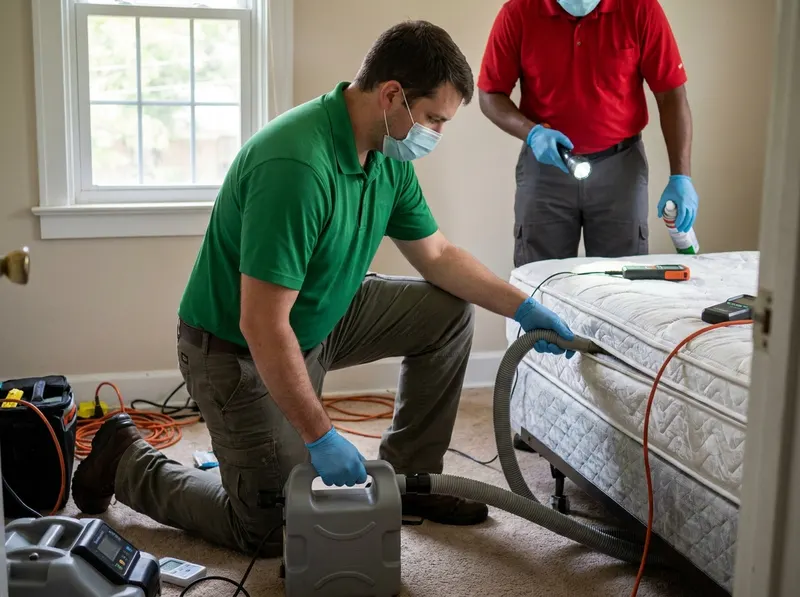
Bed bug remediation balances localized structural biology against insect life cycles. In historic plaster construction common to Highland Park, Forest Park, and Five Points South, bed bugs harbor within settled molding, deep baseboard cracks, and behind electrical faceplates. In modern slab foundations and apartment complexes near Avondale, Crestwood North, and the UAB Campus corridor in Glen Iris, bed bugs navigate shared utility lines and drywall chases. Standard consumer chemical aerosol foggers fail to penetrate these micro-harborages; aerosol propellants often trigger behavioral dispersion, scattering egg-bearing females deeper into wall assemblies and adjacent bedrooms.
Targeted remediation relies on verifiable thermal thresholds and desiccant barriers. Exposure to temperatures exceeding 122 degrees Fahrenheit eliminates adult insects, nymphs, and eggs within minutes by denaturing structural proteins. For sensitive items, localized high-temperature dry steam combined with HEPA vacuuming physically reduces harborage pressure. Technicians follow with microscopic applications of amorphous silica desiccant dust injected into wall voids, outlet boxes, and floor joints. This inorganic desiccant absorbs the protective waxy epicuticle layer of the insect exoskeleton, causing fatal dehydration without leaving persistent synthetic neurotoxin residues in active living spaces.
Decision guidance depends on room contents and structural containment. If an infestation is localized to an isolated guest bed or single recliner in Crestline Park or Smithfield, targeted spot steam and botanical barrier isolation offer immediate containment while keeping costs closer to the $150 minimum diagnostic threshold. If physical inspection confirms spread into multi-room baseboards, acoustic drop ceilings, or upholstered furniture seams across older homes in Roebuck Springs, a comprehensive whole-structure thermal program is required to prevent re-emergence. The trade-off is preparation time versus residual longevity: localized barrier dusting requires minimal furniture displacement but demands systematic re-inspection at the 14-day mark to neutralize hatching eggs, whereas whole-structure heat eliminates every life cycle stage in a single 6-hour cycle but requires temporary relocation of heat-sensitive items.
Every job gets a firm, written price after a free on-site visit.
Tell us about your bed bug remediation job in Birmingham and we'll send a clear, written quote, usually the same day.
 Brevora Pest Solutions