Occasional invaders in Jefferson County migrate toward structural foundations during specific environmental shifts, particularly prolonged midsummer droughts and saturated autumns near Red Mountain Park and Ruffner…
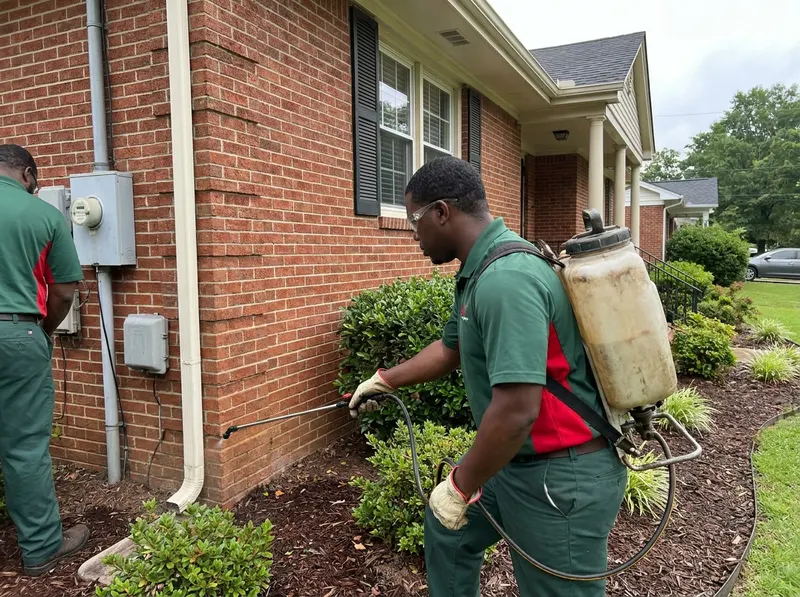
Occasional invaders in Jefferson County migrate toward structural foundations during specific environmental shifts, particularly prolonged midsummer droughts and saturated autumns near Red Mountain Park and Ruffner Mountain Nature Preserve. Mature shade canopies in historic neighborhoods like Highland Park, Forest Park, and Glen Iris create damp leaf litter against brick and limestone foundations. When exterior humidity drops, species like the greenhouse millipede, cave cricket, and common earwig move into subflooring, finished basements, and ground-level living quarters. A dedicated barrier application halts this migration by stopping pests before they cross the exterior threshold, reducing interior chemical usage.
Selecting a targeted perimeter barrier over an internal broadcast fogging aligns with modern integrated pest management standards. Interior sprays disperse chemical residues where pets and family members dwell, yet they address only the pests that have already breached the perimeter. By contrast, an external perimeter treatment places a specialized water-resistant micro-encapsulated formula directly onto the lowest 3 feet of exposed masonry and extending 5 to 10 feet out across adjacent turf, pine straw, and foundation beds. The trade-off is mechanical: dense shrubbery or stacked firewood touching exterior walls in Crestline Park or Crestwood North must be pulled back at least 12 inches to ensure uniform chemical continuity.
Execution follows an exact sequence. First, the exterior foundation perimeter is inspected for structural breach points, unsealed pipe penetrations, and loose basement window wells. Second, organic debris such as compacted oak leaves or mulch banked directly against the siding is pulled back 6 inches to expose the true soil line. Third, a low-pressure spray deposits a continuous crystalline barrier along foundation masonry, basement thresholds, crawlspace vents, and garage door skirts without broad broadcast drift. Fourth, a localized silicone or copper mesh sealant is seated inside any unmeshed brick weep holes, eliminating primary crawlspace access points common in Avondale, Five Points South, and Smithfield ranches.
This application does not replace active subterranean termite treatments, nor does it resolve established German cockroach or bed bug populations, which require dedicated structural protocols. In areas like Roebuck Springs where natural springs elevate soil moisture, barriers degrade faster under continuous hydraulic pressure, typically requiring reapplication every 60 to 90 days during peak biological activity rather than a single annual visit.
Every job gets a firm, written price after a free on-site visit.
Tell us about your occasional invader perimeter barrier job in Birmingham and we'll send a clear, written quote, usually the same day.
 Brevora Pest Solutions