Carpenter ant structural management targets the biological root of wood excavation rather than relying on broadcast chemical sprays that disperse worker ants deeper into framing. In historic homes throughout Highland…
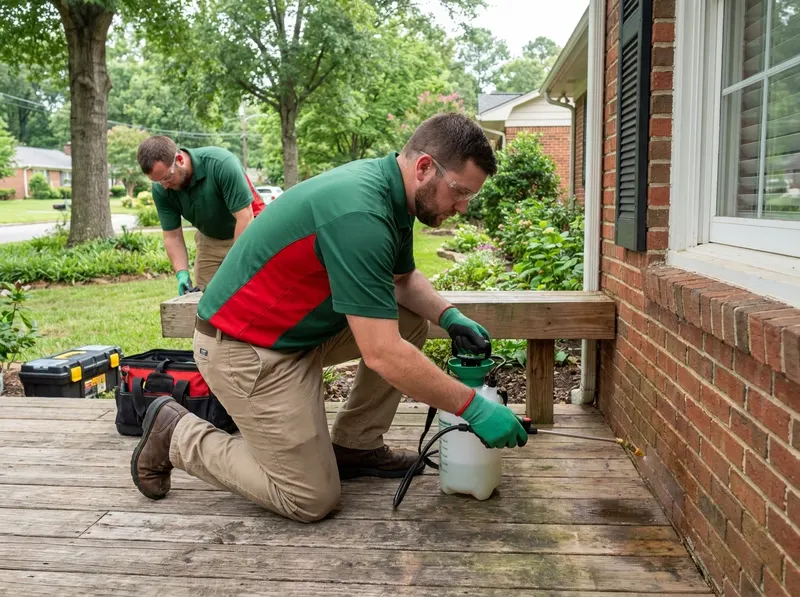
Carpenter ant structural management targets the biological root of wood excavation rather than relying on broadcast chemical sprays that disperse worker ants deeper into framing. In historic homes throughout Highland Park, Forest Park, and Glen Iris, aging heart-pine studs and historic sill plates often absorb ambient dampness, creating the high-humidity softwood pockets that *Camponotus pennsylvanicus* requires for brood rearing. Carpenter ants do not ingest cellulose like subterranean termites; they excavate galleries along grain lines, leaving behind telltale piles of coarse, sawdust-like frass containing insect parts. Treating these wood-boring pests requires locating the primary moisture fault, often near older stone masonry, roof valleys, or crawlspace subfloors, and injecting targeted, non-repellent active ingredients directly into structural voids so foragers track the material back to the reproductive queen.
Property owners in heavily canopied Birmingham neighborhoods such as Crestline Park, Crestwood North, and Avondale frequently encounter satellite colonies that migrate inside via overhanging oak limbs touching exterior fascia boards. When satellite nests establish behind kitchen wall assemblies or shower enclosures, standard retail over-the-counter sprays merely sever exterior pheromone trails, causing the colony to fracture into two or three secondary reproductive pockets within adjacent wall cavities. A systematic approach combines precise structural injection with tree-to-structure canopy pruning recommendations and botanical exterior ground bands. This protocol secures structural framing around load-bearing members without depositing persistent broadcast residues across living or food preparation surfaces.
1. Initial structural diagnostics measure crawlspace moisture percentages, map exterior forager trails, and locate hidden gallery voids using acoustic sensing.
2. Targeted non-repellent formulations are applied directly into confirmed wall voids and moisture-damaged framing members.
3. Exterior perimeter barriers are established along foundation footings and soil contact zones, creating an undetectable transfer zone that neutralizes the parent colony.
Single-point localized nest treatments suit isolated window-casing activity where water intrusion remains minimal, requiring 45 to 60 minutes on-site. Extensive whole-structure protocols fit historic multistory residences near Red Mountain Park or Roebuck Springs where multiple satellite nests span attic rafters, crawlspaces, and exterior landscape timbers. The trade-off between localized void injection and comprehensive structure-wide management balances upfront treatment area with long-term gallery expansion: targeting only one active room leaves untreated satellite colonies intact if moisture migration extends across adjacent framing.
Every job gets a firm, written price after a free on-site visit.
Tell us about your carpenter ant structural management job in Birmingham and we'll send a clear, written quote, usually the same day.
 Brevora Pest Solutions