Subterranean termites nest underground and enter homes through hairline foundation cracks as narrow as 1/32 of an inch, seeking cellulose framing inside wall cavities, sill plates, and subfloors. In older Birmingham…
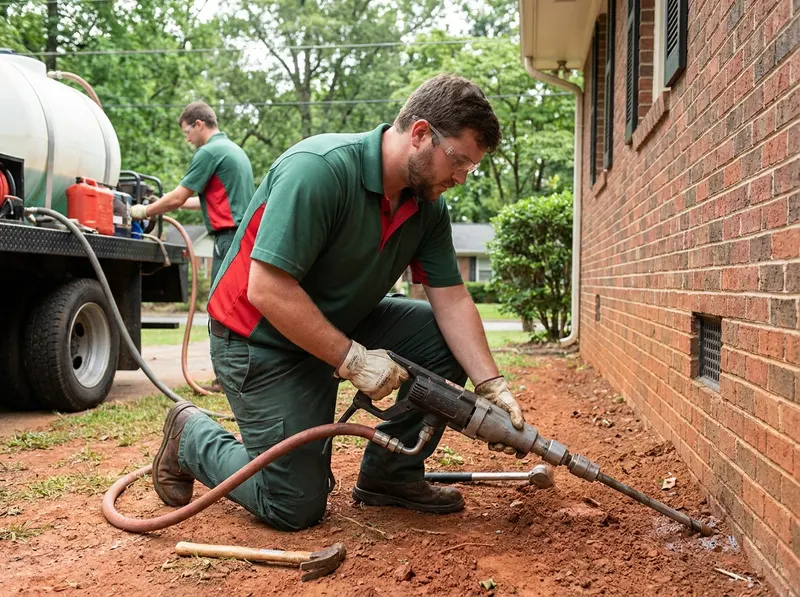
Subterranean termites nest underground and enter homes through hairline foundation cracks as narrow as 1/32 of an inch, seeking cellulose framing inside wall cavities, sill plates, and subfloors. In older Birmingham residential pockets such as Highland Park, Forest Park, and Five Points South, historical crawlspaces and aging stone or hollow-block foundations expose structural timbers directly to moist native clay. Homes built on sloped grades near Red Mountain Park and Ruffner Mountain Nature Preserve frequently feature earth-to-wood contact along rear decks and basement retaining walls, creating continuous moisture corridors that subterranean foragers exploit.
Treatment selection depends on architectural design and soil grading. Continuous liquid soil treatments create an uninterrupted non-repellent treated zone along the foundation perimeter. Foragers pass through the treated soil without detection, transferring the active material back through the subterranean colony to cause total colony collapse over 60 to 90 days. For concrete slab foundations common in parts of Crestline Park, Glen Iris, and Crestwood North, technicians drill small, 1/2-inch vertical holes spaced 12 inches apart through abutting driveways, carports, and patios to inject the liquid barrier beneath the concrete. In contrast, inground baiting networks fit properties bounded by decorative stone, established landscaping near the Birmingham Botanical Gardens corridor, or high water tables where digging deep continuous trenches is structurally impractical. Bait systems utilize insect growth regulators that disrupt worker molting cycles, requiring zero indoor chemical distribution.
Homeowners often evaluate spot treatments against full perimeter installations. A localized spot treatment halts termite activity inside a single 10-foot stretch of baseboard or crawlspace joist for an immediate containment cost, but leaves the remaining linear perimeter vulnerable to subterranean foraging tubes. A continuous 360-degree perimeter barrier requires higher initial material volume and labour to trench and rod down to the top of the foundation footing, yet provides verifiable whole-structure defense without annual subscription mandates or broadcast chemical spraying inside living quarters.
Every job gets a firm, written price after a free on-site visit.
Tell us about your subterranean termite treatment job in Birmingham and we'll send a clear, written quote, usually the same day.
 Brevora Pest Solutions