Subfloor environments across Jefferson County face unique structural pressures due to high annual rainfall and clay-heavy soils. In older residential areas like Forest Park, Highland Park, and Glen Iris, historic homes…
Subfloor environments across Jefferson County face unique structural pressures due to high annual rainfall and clay-heavy soils. In older residential areas like Forest Park, Highland Park, and Glen Iris, historic homes built over unsealed dirt crawlspaces routinely absorb ground evaporation. This elevated relative humidity pushes wood moisture content beyond 19%, creating ideal biological conditions for wood-decay fungi, drywood termites, and subterranean termite colonies migrating from nearby ground shelters near Red Mountain Park. Unprotected crawlspaces also offer harborages for invasive smokybrown cockroaches, silverfish, and field rodents entering through foundational foundation weep holes or cracked stone work.
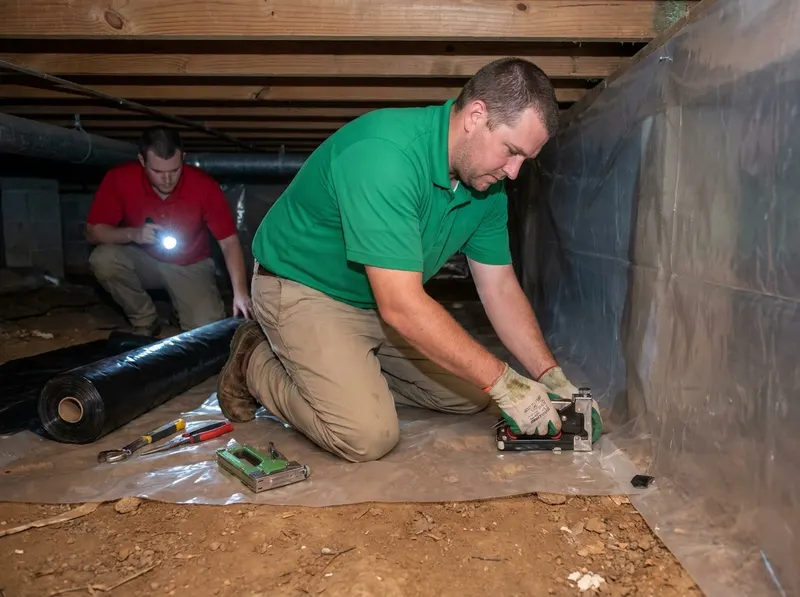
Installing a durable crawlspace barrier establishes a physical division between raw earth and wooden floor joists. The system fastens a heavy polyethylene sheet directly to foundation foundation walls six inches above the exterior grade, securing all seams with acrylic seam tape to prevent vapor seepage. While standard plastic sheeting degrades within a few seasons under soil microbes, high-tensile 12-mil to 20-mil cross-laminated liners withstand direct traffic during plumbing repairs. For neighborhoods with older sandstone or brick perimeters, like Five Points South and Avondale, technicians seal foundation vents and plumbing penetrations with non-shrinking foam barriers to isolate subfloor air from external summer humidity.
Property owners evaluating moisture mitigation choose between partial dirt covers and complete sealed encapsulation. A flat ground-barrier deployment covers exposed soil to curb foundational humidity at a lower cost, which fits dry properties in Crestline Park or Crestwood North where exterior drainage is already well-managed. Full encapsulation integrates wall-mounted barriers, taped support piers, and dedicated dehumidification units, preventing indoor fungal spores and stabilizing floor temperature shifts during humid summers. While partial barriers preserve passive crawlspace ventilation, complete sealed liners eliminate the stack effect that draws musty odors and pests upward into primary family bedrooms and living quarters.
Every job gets a firm, written price after a free on-site visit.
Tell us about your crawlspace moisture & pest barrier installation job in Birmingham and we'll send a clear, written quote, usually the same day.
 Brevora Pest Solutions